In mid-June of 2026 in San Francisco, I went to a screening of Whispers by Bernie Su with Pickford. It is of the most exciting performances with AI tooling for empowering storytellers. To be honest, I didn’t know what to expect and didn’t read the Forbes article about the LA screening. What I got was a great glimpse into how AI can be used as a creativity support tool for storytellers and as an interaction tool for the audience.
The Detective and the Voices
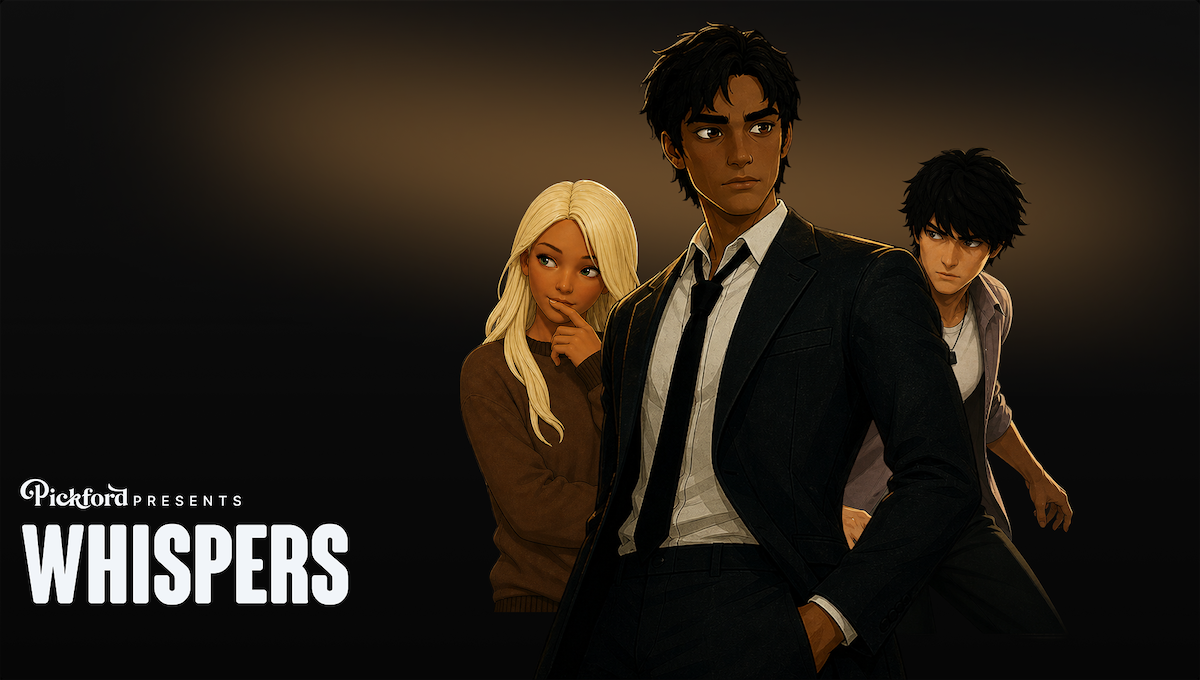
So in a small theater room at the Alamo Draft House, Bernie gave us a breakdown of what was about to happen. This is interactive cinema in a murder mystery. Our protagonist, Marcus Kent, is a detective who hears voices (or whispers) in his head as he solves crimes. He has an assistant and a girlfriend. Thne there’s a handful of suspects and, of course, a deceased person.
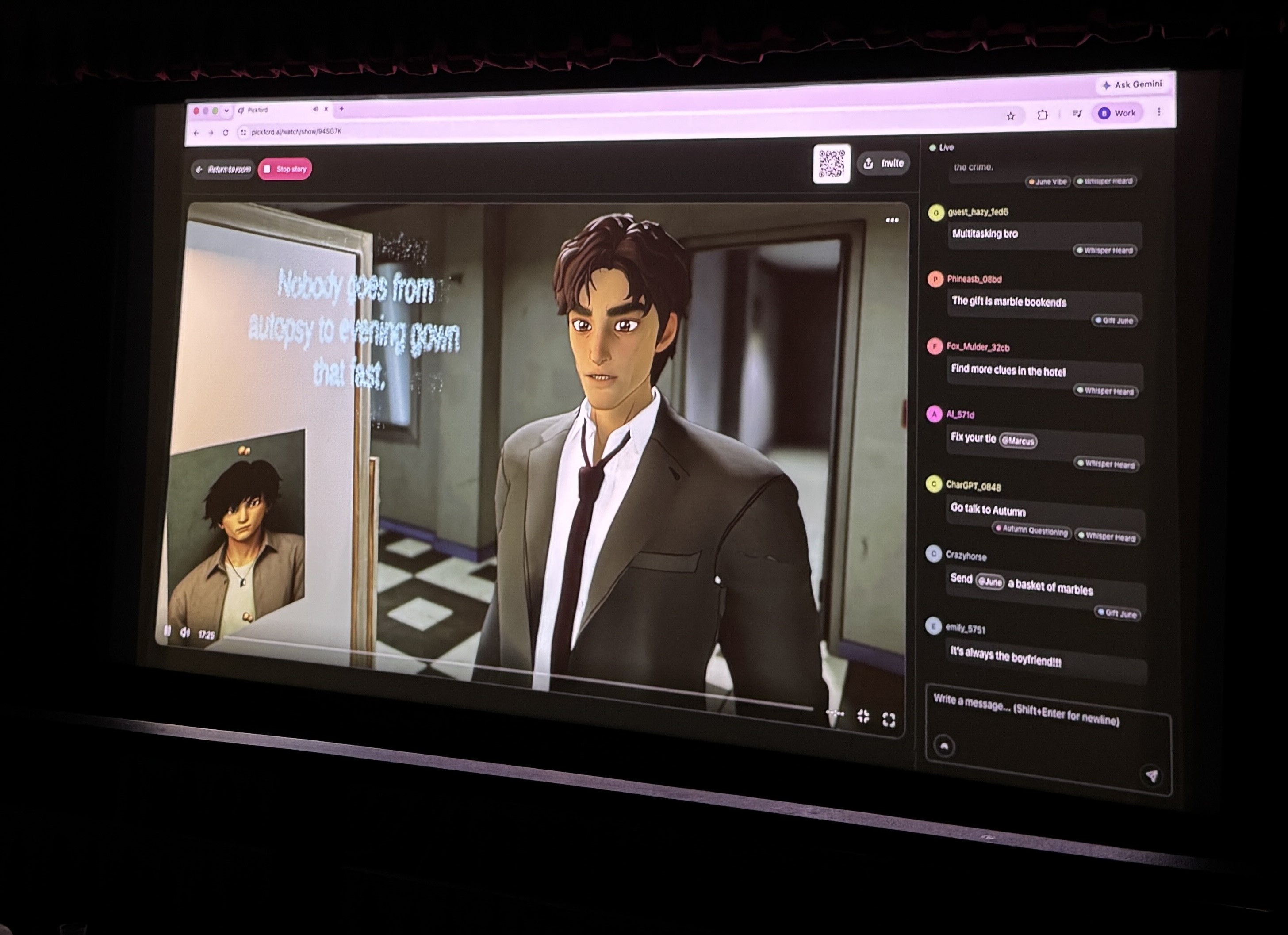
Here’s where it twists. The story and animation is rendered in real time. The system randomly picks the killer at the start of the show then builds the story. But the real hook is the audience participates by typing and sending those whispers to Markus to help him solve the crime. As an audience member, you scan a QR code, pick a screen name, and you see this as a chat style window in a sidebar on the screen (and see the whole chat on your device). Other audience members can 👍🏽 up vote other thoughts.
Our Screening
In the chat bar, you can see in real time what the AI is thinking about the whispers sent in. Some are off-topic, some are heard, some have a consequence like “Autumn Questioning” in the image above. Before the show, Bernie told us you can’t really give Markus a direct command like “High five Richard” and see it rendered in video; the audience only gives Markus thoughts. In one scene, likely an artifact of the 3D engine and human models on hand, the coroner at the morgue took off her lab coat and was wearing an evening gown underneath. I found this suspect so I whispered to the detective “Nobody goes from autopsy to evening gown that fast.” Later on, back at the office, the detective heard this whisper and decided to act upon it. The system displays the quote on screen and then kinda dissolves it out when this happens.
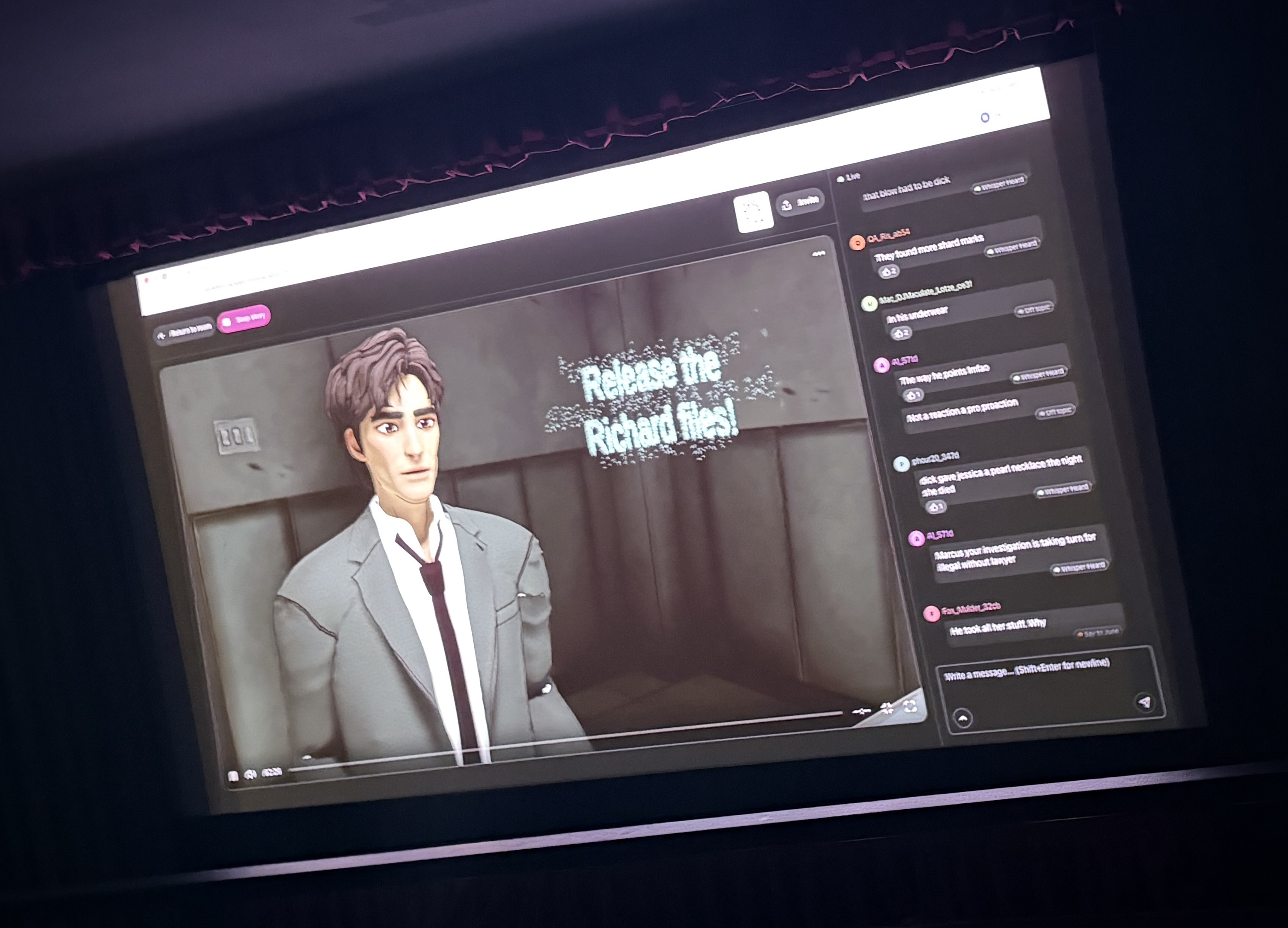
The rest of the audience thought the killer was a 20 year old content creator dude. So Markus went on a quest to interrogate him which was a wild goose hunt. As it fizzled out, my whisper to suspect the old rich white guy reactivated.
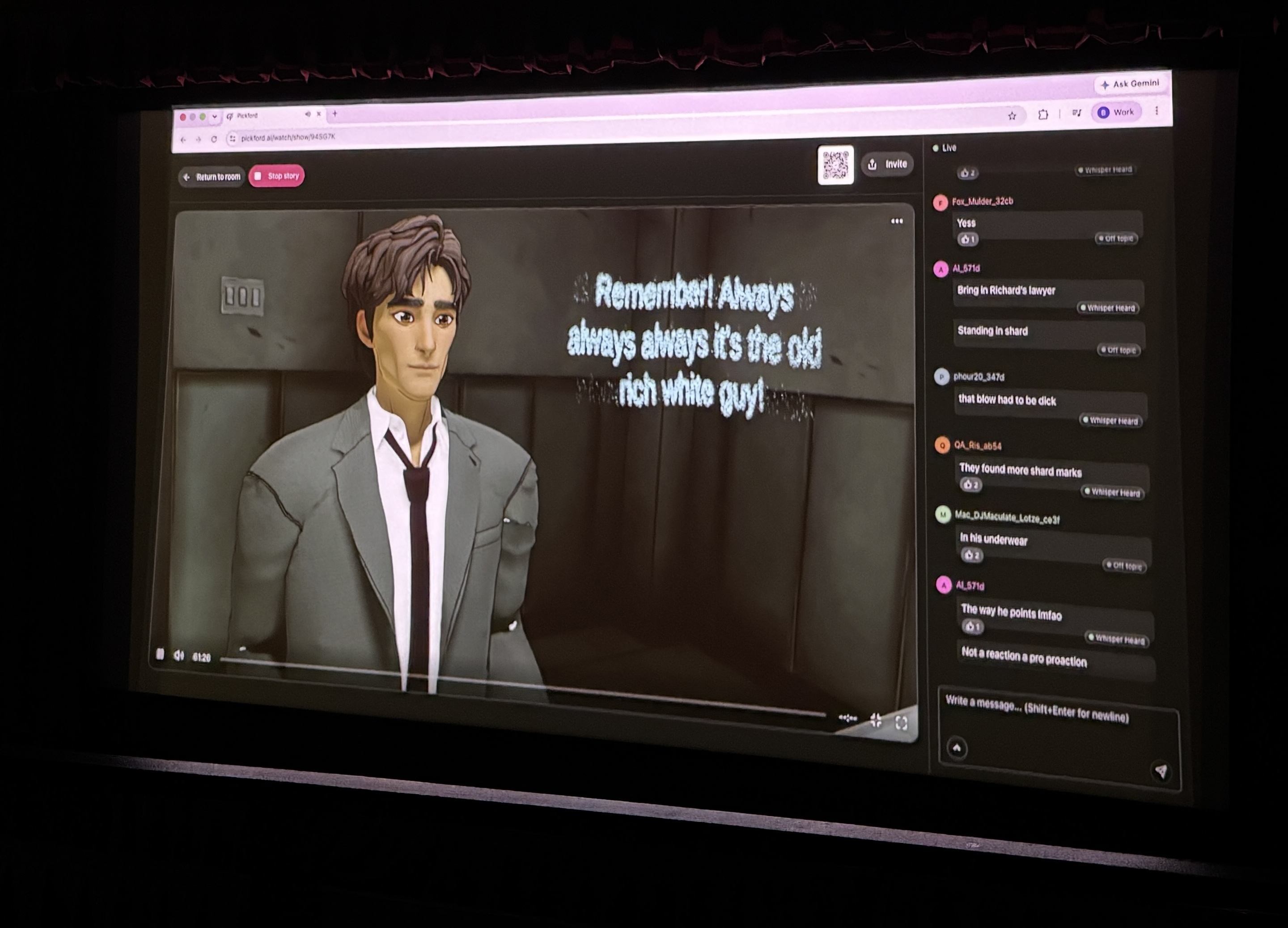
I gotta say, this is very satisfying and not everyone got quotes displayed on screen.
At the end of the show, in the credits, the system gives props to whisperers who had a strong influence. That’s me: Shamurai_bac4 as Chief Voice Validator. It was great to see my handle roll by at the end!
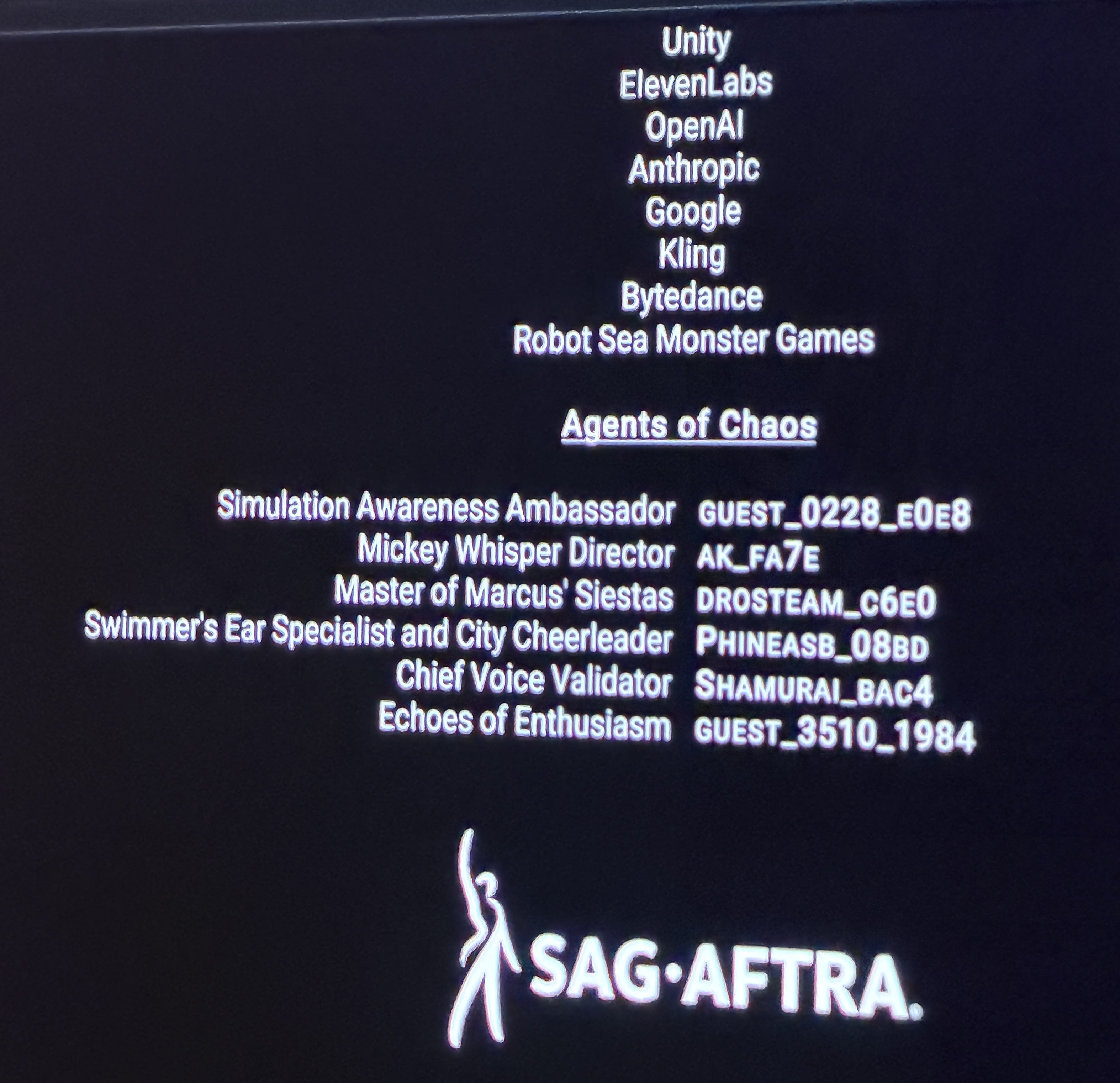
There’s also a “B Plot” about Markus trying to get a gift to his girlfriend because they are having troubles. Someone suggested “Marble Bookends” which the character picked up on and made up a whole backstory about why they were a good gift citing she’s an avid reader and has books in vertical stacks throughout the apartment, so this would be a good gift to show that he cares about her interests and hobbies.
Why This Matters: AI for Creativity Support
The runtime of the episode was probably about 45 minutes. Afterwards, Bernie took some of our questions. Now this is all experimental, so I’ll stay away from the commercialization aspects which were asked. Instead, I was curious about the story. Bernie wants to write and to tell stories. Do to this, he needs to control the narrative and control the chaos. How as a storyteller does this system work? Using the AI system they developed, he’s able to tune it and keep the actors on topic with some creative control (so Markus doesn’t decide to quit and become a chicken farmer). He can set up the B plot and figure out how much time to devote to things. In particular, it takes time to go from audience whisper to rendered scene (maybe 60 seconds or something like that) so there’s some advantage to interleaving threads computationally for flow.
In the Forbes article, they noted non-sequitur creativity can still influence the story:
The hour-long screening generated several hundred “whispers” to the detective, including a remarkably dedicated set of contributions from a small group fixated on the crime-solving capabilities of Taco Bell chalupas, i.e., something patently ridiculous that had nothing to do with the noir-ish crime mystery at hand.
Spoiler alert: it kinda worked, with an offer of a chalupa coupon enough to break the suspect and force a confession.
For the system to find something actionable, it deems it relevant. Many of my pull quotes were upvoted by the audience (who I didn’t know). Likely, the Taco Bell cohort in LA was very enthusiastic. Both causes the system to trigger on the suggestion. In reality, this can be fine or it can be destructive either as a old school ‘Google bomb’ or as a ‘rich get richer’ scenario if the AI over indexes on an individual. The latter is something we look for in recommendation systems and worked hard to counter act back when I was leading science at Flickr: the interestingness metric was tuned to thwart the effect of over-popularity.
What I enjoyed was the creativity support tool using AI, which Frank Nack always advocated to help him write and tell a story that is non-conventional. It’s a bit much to sit in a theater watching a story while chatting on your phone. In reality I hate those distractions, but this is an interaction. I’ll admit there was some fatigue watching and participating. If you want to just sit back and watch and put the phone down, that works too (though you still see the scrolling chat window). All this said, it’s still one of the best interactive cinema pieces I’ve seen and I’m looking forward to people using AI to tell new stories they want to tell rather than use AI to blindly generate them.
