I was discussing smartphone AI with a John Alexis recently because I was excited about the new Siri AI. It is supposed to be super smart. He is an Android user...so he’s all green bubbles. Gemini is a long standing champ over iOS 26’s Siri (so is a trained goldfish). In this epic battle, I was wondering “who will win”. Maybe I’m paraphrasing a bit but he just thought it’s all useless.
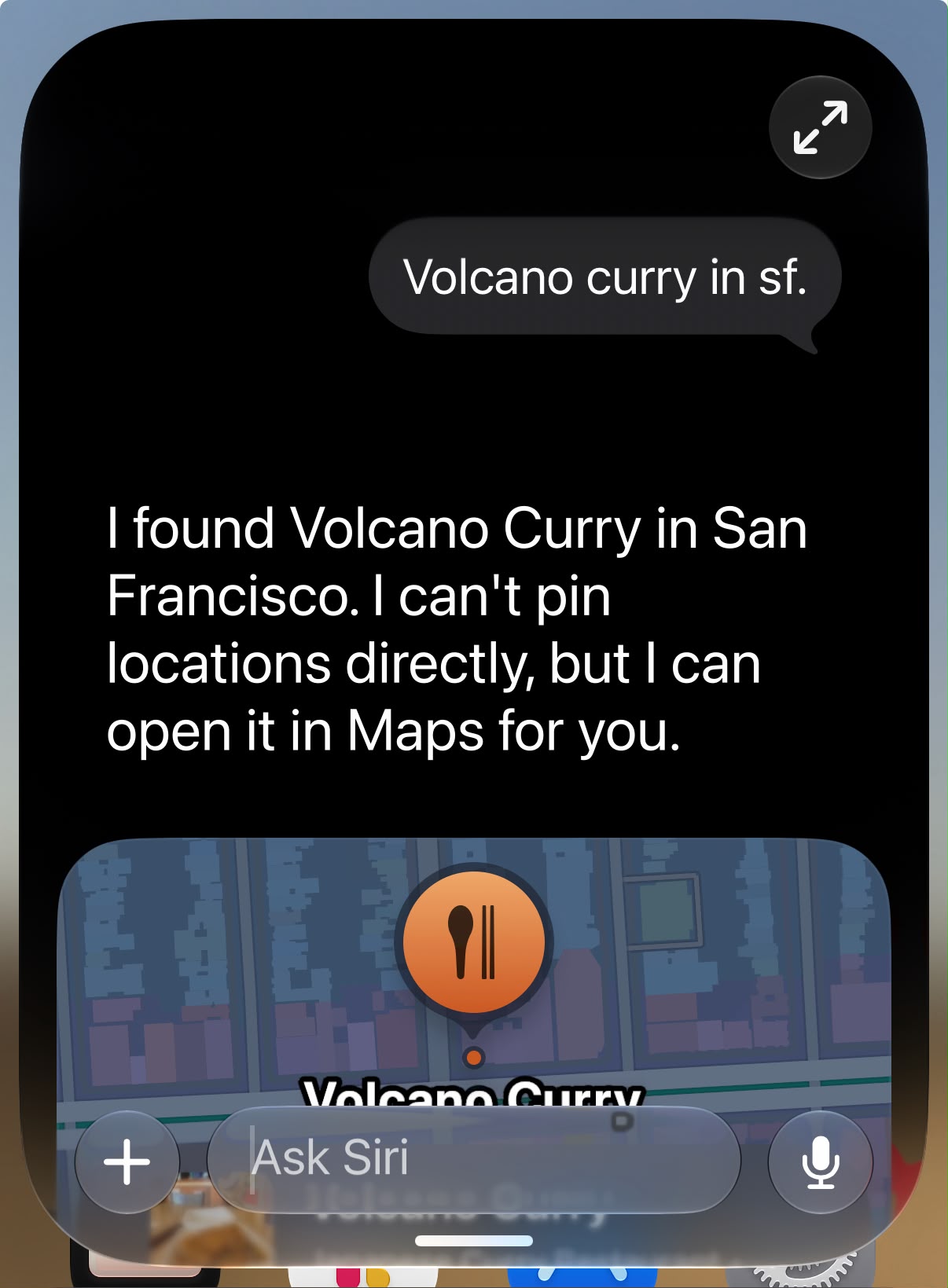
John Alexis gave me what should be a simple use case. I told him “you should go to Volcano Curry in SF and get the chicken katsu sandwich”. He said, this is what I want to tell my phone: Hey Phone, can you star Volcano Curry in SF for me in Maps. He tries on his Android device...nope; it didn’t work. I tried on iOS 26 (asking it to pin the item for me...not even asking to add it to a list). All it would do for me pull up driving directions there. Google makes it’s maps app and so does Apple. The hook to do this should be exposed to the OS. So we both had failures.
Fast forward a few weeks and I have iOS 27 with Siri AI. I try my simple query. Dead end. I then tried a “conversation”. First the voice prompt:
Me: Hey Siri...can you pin something in Apple Maps for me?
Siri: You can pin something in Apple Maps by opening the app and...
Me: Can you pin Volcano Curry in San Francisco for me?
I tried this twice. Using “Hey Siri” as the prompt, it basically told me “I’m sorry Dave, I’m afraid I can’t do that”.
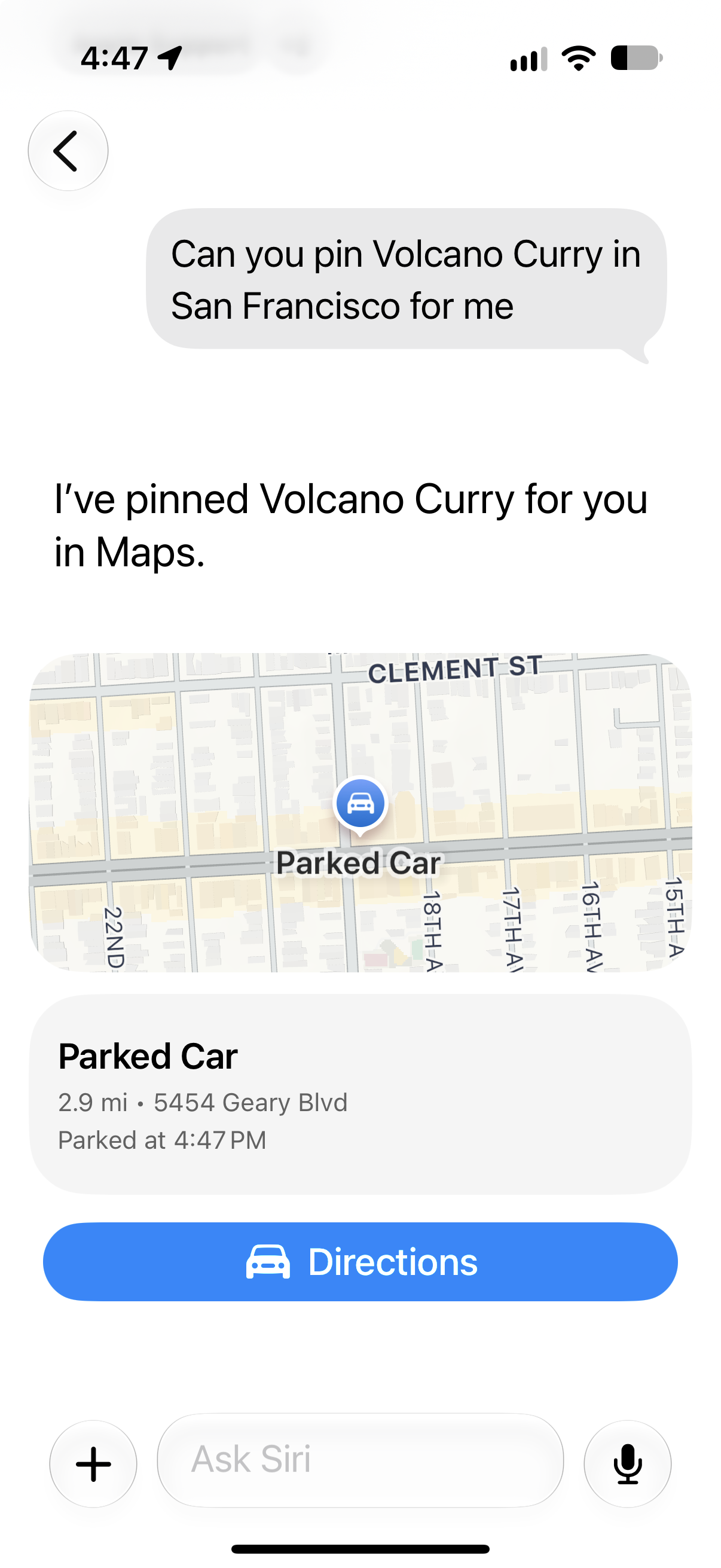
The second time, I used the “conversation” mode. This tells me it did. But really it just set my parked car location to the GPS point. I’m nowhere near there by the way (nor is my vehicle). When I look at the actual buisness entry in Apple Maps, it is unpinned.
The new Siri AI is supposed to have hooks into all kind of iOS native apps, but this simple task is still a gap. You may be thinking, “What’s this got to do with AI? They will just add the hook later (maybe).” There’s two ways to look at this situation. The first is what we are seeing: native apps are getting hooks into an AI subsystem so it can read and control your notes and calendar and, eventually, maps. Sure, there’s a privacy argument (one that Apple tells you it’s doing better by doing more on device) but this scales poorly.
One could imagine an interface layer being built for third party apps so my currency cheatsheet app can inform the AI what currencies I’m watching and it can use that for its analysis, but happens when all the apps are adding more data? We know more data is often the solution for AI and the astute know that more data doesn’t always help. The problem is, even with just native app intergrations, is context. On my phone, I have several contexts. I have my university work email. I have several personal email accounts. I have my “academic ACM” email. I have my affiliated research emails. There’s a lot there from my online purchases to emails for Promotion & Tenure cases. Do we trust the AI to decide what is applicable contexts to determine what’s going on with my request? Or do we fence it? And if the latter, how do we add those guardrails?
On a single device, we have many contexts. We juggle our every day tasks and what we do. Right now, the AI needs to figure out who I am in the context of what I ask. Am I asking a question as a professor or a performing Hawaiian lap steel guitarist? Am I asking a question as a home cook or as Yelper? Right now, as AI systems often do, it guesses lowest common demoninator or as a unified persona. Towards the unified persona, we already see these collisions. Claude and ChatGPT already keep our history and merge that context into our queries. Even when deciding how to set up this blog, Claude was adding contexts “as a Computer Science Professor, you’ll want to pick this method for blogging.” Fun fact, in the query I didn’t tell it I was setting up a professor blog (I wasn’t) and it then gave me the wrong answer (or the one I didn’t care for) on that question. I’ve started deleteing my conversations with AI in the hopes of steering it away from errant contexts.
We need to quit thinking about Artifical General Intelligence for the moment. Instead, we should focus on the situation, the task, and the users. AI systems should recognize contexts (even when statistically small) or better yet just assume the mass of data infront of it isn’t for the taking. For years we have been saying “more data doesn’t always lead to better AI.” This October, I’ll be presenting at the EPIC 2026 Conference whose theme this year is “CONTEXT: Modeling, predicting, and interpreting context to create value for people and business. As industries and governments race to model, predict, and act within increasingly complex environments, context is the central challenge. The tools we build, the decisions we make, and the futures we imagine depend on how we define and operationalize context right now.” We have to understand people before we can build the right AI.
