In April 2026, I co-ran the ACM CHI conference in Barcelona. Most people who know me know I am no stranger to academic service work. Some people go as far to call me a fool or sucker pretty much to my face. Whatever, I’m old enough not to care to much about all that. For CHI 2026, we tried to keep everyone informed. We ran a blog and sent emails and tried to keep everyone in the loop with what was happening as it happened. We blasted all our social channels (and even found out how to access the lost Mastadon account as somoene requested it).
There’s a few things that, upon reflection, are probably not visible to most people following along. When you run a conference the size of CHI there’s so many things you never expect. A lot of things need consideration, time, and consideration. Many of them came as a surprise despite having been on the SIGCHI EC, TPC for CHI 2022, and the CHI Steering Committee. So here we are with a click bait title; this post is just to explain some of the surprises for visibility to future chairs and attendees. What you should take away from this post is not how to blame the system or other people, rather how to look at the running conference and how we took the unexpected.
Oversold and Undertracked
We blogged quite a bit about the registration surge. We got a last minute landslide before early bird deadline and had to put on a wait list. Why? Because everyone didn’t register yet. We can’t have best paper award winners who can’t get into the conference. Our hired project management team put on their plan with a wait list. This was informed from 2025 selling out in the days before the conference. From here, a few things went wrong.
First, the wait list was just an email address. It should have been a form and a ticketing system. There was a run to get something put up fast and for whatever reason ’email us’ was the plan. By the time I caught up to what was happening, it was several days later. Sorry...ask me IRL why I was unreachable during that window...
The email wait list method was in full effect. Emails in a inbox just grew to become something untenable in a few short hours. But we were scrambling to make sure authors could get in, then presenters, then others. There was a lot of manual accounting and double checking. The good news is it kinda worked. The bad news is: this was the worse way to process things.
The problem is clear: there is no way to ensure who registered for a paper. Lets say my submission chi_paper_1234 is accepted. I have 3 co-authors. One of us has to register. My email in PCS might not match my email on the paper which might not match my email in the registration system. There’s a field that says ‘are you registering for a paper’ but that free text field has a lot of noise in it. Then there’s the case where ’none of the authors can make it but this other person will present the paper’.
So how do we fix this one? We would need to track who registered. Probably the best route is to give people a code like 08c167984f27a26ebaecbd64914917ab to use when registering for the paper or panel or whatever. We could check this against a hard list and just know who didn’t register yet. Then we use the count of the total codes generated to hold n number of registrations. Why not just use the paper number? Too easy to guess and spoof. The bigger issue is, even implementing this requires tooling be built as it’s not in the workflow of PCS, TAPS, and CVENT.
The bigger AI conferences open registration up for authors first then general attendees. I don’t think that would work well for us given we have a greater number of submission types and we don’t have ten thousand people to host (yet). So quite honestly, we need bigger venues to start (this venue was picked years ago...before the paper boom). Then we need to track who is registering with precision. Finally, if we have to go to a wait list, use a proper ticketing system.
Designing a Budget and Actual Costs
Generally speaking if you read the comments, people complain that CHI costs too much. The actual price of the conference didn’t have an increase for several years. It has only been in the post pandemic CHIs where the Executive Committee allowed for an increase in registration. For CHI 2026, we were entitled to a 5% increase which, after a few years of a 5% cost lift, would put us at parity with other ACM conferences with regards to registration fees. However, given how we budgeted, we did not need to levy the extra cost. Holistically, CHI is expensive because one has to fly and get lodging...not because of a registration. Thankfully, we were able to keep the cost flat.
When it comes to budgeting, my co-General chair and I were not penny pinchers. Saving 15 bucks here and 70 there is not how you minimize costs...you have to look at the high ticket items. This is food and beverage and WiFi and venue. Every meal (priced by how many people are there not how many people are eating), every IP address (we budgeted 3.5 addresses per person), every install of AV (including all the hard ethernet lines for each demo), and every time a room needs to be secured or opened; it all costs money. We did a great job with our management team getting space and keeping those costs at educated estimates for the budget and responsibly quoting how many sponsors we’d land and how many registrations we’d get.
Now you’re probably saying “you messed up” because we estimated 4,100 people and got over 5,000. You’re not wrong but the game here is not to make a budget where you say “I will have 8,000 people...look at all this surplus!” In fact, as a non-profit, the ACM asks that we be conservative. Given CHI 2025 had 5,000 people (many from eastern Asia), we assumed we wouldn’t get those registrations. Further, we assumed traveling from the USA would be difficult for many so there would be a drop there. Kinda everything was wrong. People from the USA came in strong and we had parity with registrations from Asia next to the USA; plus Europe came in with numbers. Let’s rewind. The Steering Committee, Executive Committee, SIG Governing Board, and the ACM all thought we wouldn’t see a surge in registrations. They also all thought Japan 2025 would see a drop in registration. They also all thought Hawaii 2024 would be a significant cut back due to the sustainability concerns from the community. All wrong. This is not to blame anyone (I can’t say this enough), but to show a lot of eyes and insights went into the estimates. And to be honest, I didn’t think we’d clear 4,000 people and that we’d take a loss. Moving forward, we’ll probably see the estimates are less conservative.
So where are we at? Good I’d say. First, we need to think about CHI being a bigger event than it was. We could have easily accepted 6,000 people into the conference in 2026 if we had space. We’ve been too conservative. Next, we need to look at losses and surplus. CHI 2021 (having to switch to virtual) had a healthy surplus. I was part of the 2022 team that ran the first and only truly hybrid CHI and we took a heavy loss because that costs money (to my memory it was 500k USD). Hamburg in 2023 also took a small dive (guessing 300k). Then post pandemic, it flips. CHI 2024 in Waikiki had about 160k of surplus. CHI 2025 in Japan, because of several sponsorships that flooded in, had well over over 1 million dollars in surplus (which fairs well for the SIG’s pandemic hangover). CHI 2026, while still finalizing, will register a modest surplus USD because of the registration surge. A long time ago, SIGCHI Operations setup a webpage where anyone can see the incomes, expenses, and registrations of SIGCHI conferences.
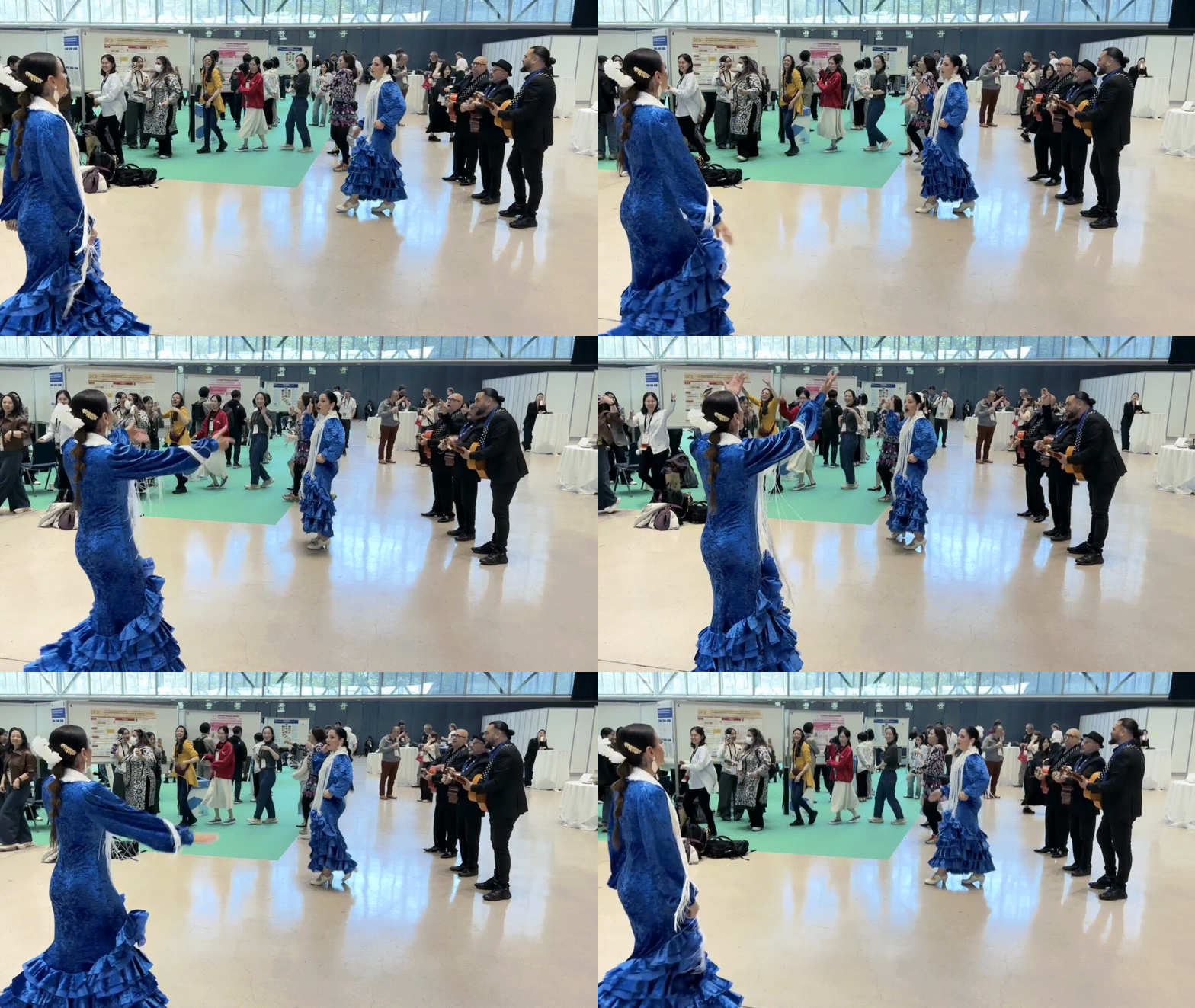
Once one sees there will be a surplus, there is an updside! The GCs can enrich the conference experience. First thing we did was add more infrastructure to the WiFi (and it still had issues). Then, we upped the food program (which was delicious and easy to get to). With the help of our amazing Local Chairs, we got a Cataluyian Rhumba band to play a the job fair and bring some high energy into the space.
Lines Everywhere
We kicked off the conference with an amazing performance and a fantastic keynote by Pep Gatell. Then the paper sessions started and there were long lines to get into the rooms. Our SVs were great in controlling the rooms and the lines. We can’t have people standing in the back of the room as that causes a fire code violation and it blocks accessibility to those who need it. I started going into these rooms to do head counts and see what’s happening. Most of the SVs thought I was trying to cut the line. 🤣 When I politely explained I’m a GC and they were cool; most of the SVs recognized me but I was sneaking into a dark closed session so things happened). I popped into one room and counted like 30 full seats. There was probably 50 people in line to get into this room. Outside the room I turned to the SV and said “why does it look like you’re selling Taylor Swift tickets?” He said “There are 6 papers in this session, three best papers and two honorable mentions.” At the same time, I had seen that we have large rooms that were pretty empty. Immediately, I saw the problem.

I ran back to the chair’s office and assembled the TPCs (who schedule the rooms). We had hit a process issue. Paper chairs make sessions. TPCs assign them to rooms. After this, the Award chairs finalize the awards. There was no ’loop back’ step to see if award papers were in small capacity rooms. We were just following how every other CHI did this workflow. We never sold out like this before. There was an emergent error, we identified it. The TPC and their amazing assistants worked all day to reschedule the rooms. Then we had to update QOALA and the Programs app. We also had to update the digital signage with the convention center. It was a lot of work and we mostly solved it on the spot. There were still some small rooms with lines but things went better once corrected.
We noted what happened in the town hall. We also noted what happened to the Steering Committee. I personally told the CHI 27 chairs they need to monitor this workflow as this issue can re-occur. A lot of what you do when you run a large conference is cut and paste. Just follow the past workflow. Just use the past website’s information architecture. I don’t mention this oversigt in process to blame anyone in the chain. The paper chairs, TPC, and award chairs all were on point. Sometimes you hit an operations snag. It’s impossible to just rebuild it all from scratch, but it’s important to monitor and improve. I’m glad we caught this one.
One interesting side effect here is the effect of a paper award. People have done a lot of post analysis on ‘does winning a paper award drive more citations?’ or ‘creates lasting impact for the paper?’. One thing we do know (that is often missed from these restrospective data studies), awarded papers get bigger audiences at the conference.
Plushiegate
The plushie brings smiles and joy to the whole conference. We worked hard on designing a plushie to represent Spain, Catalonia, Barcelona, and just be fun and cute as a button. For 2026, we had a pre-order for the plushie. Not that there were ever unsold toys at the end of the conference, but personally I never liked the scrum to get in line and try to get one. We worked on a design using a cute burrito (a symbol of the region) and named it CHImo. It was all on track to be awesome.
It turns out, there are a lot of things in the process pipeline. There’s us. We talk to Executive Events. They figure out how to source the item and they work with an importer/exporter who has their connections. There’s not a lot of transparency in the overall stack. The snag we hit came around in the export process from the factory. The pushie wasn’t cleared to enter the EU into Spain. We could have shipped it to France and then muled them across the border (pun intended) or found a different importer/exporter. The GCs and Executive Events found this all out too late...we tried to scramble but it just wasn’t gonna happen.
We formulated a plan to refund everyone while the conference was running. I drafted an email in a google doc telling people they will get refunded and if they get to CHI 27, they can pick one up for free. The conference would just eat the cost of the toys. The doc was called “plushiegate” as I gave it a funny title as I wrote the letter at 1 AM. Our registration team titled the email with the doc title. The next day, someone outside the organization committee came up to me and said “I’m sorry about Plushiegate”; I realized what just happened. I still chuckle and happy the reg team had fun with it. In the grand scheme of things, a missing plushie is minimal to the success of the conference, but was still a disappointment we had to face.
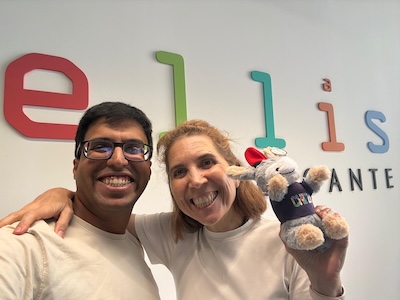
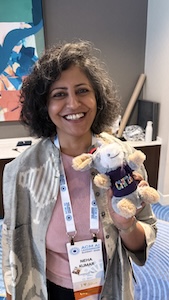
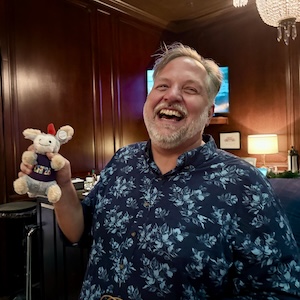
CHImo did make it to the USA finally. I have delivered to a few to people that I’ve encountered. He even made it to Spain! If you’re heading to CHI 27, CHImo will be waiting there for you!
Found Family
This is a sensitive topic. When you volunteer for a conference, it’s a lot of work. To be a TPC or a GC at a conference the size of CHI requires years of that work. You’re on calls with people all the time and on the regular and at off hours (time zones cannot be solved). Everyone with you on the journey is family. For me, with years of hardened corporate training, you’d think it’s best to just keep it as a volunteer job, do the work, add it to your resume and go on. But, in reality it’s found family if not also forced family.
So what does this mean? Family loves each other and cares. Family disagrees. Family finds consensus. Family puts its foot down. Family forgives. Family argues. It all happens. It’s messy and it’s great. Planning a conference for years takes a lot of time. Yes that’s obvious but in practice things happen. People get married and go on honeymoon. People lose their jobs. People have babies. People get sick or injured. The train doesn’t stop...the conference keeps going. As a GC, I found you have to give people space and care. You have to do this first. Don’t start with ‘well who will take over you job’! Just help the individual first...worry about the logistics second. Even at the conference, emergencies happen. You have to help your people and your committee and your attendees first and fast and be there. I’m not going to name names here but if you’re reading this and you had something that was an issue, I hope we did our best to accommodate you. And if you’re someone I frantically came up to because I needed a substitute or help at the last minute: you’re the real hero!
Would You Do This Again?
When I was TPC for CHI 22, I was asked by a CHI Academy member “I bet if you had a time machine, you’d go back and stop yourself from taking this role.” Now, I didn’t give any indication of that and likely it was their feelings perhaps about when they did a service role. I said “No I loved it and am proud of everyone who was on the committee with me.” Later that day, someone else then asked me “So when will you GC CHI?” I said, “Never! I don’t think that’s for me.” Then...years later...I was approached to be GC for CHI 26 Barcelona.
I did say no initially, but it unfolded in interesting ways. I had the option to work with a friend from ACM MM as my co-GC (Hi Nuria!). And we had the chance to expand our reach regionally and work with the AfriCHI leadership. SIGCHI provided a grant to get the best young scholars from AfriCHI to CHI Barcelona and that was awesome. With the past Steering Committee’s guidance, we organized the conference as talks in the morning and experiences in the afternoons. I’m proud of everyone in our committee. You typically only do this job once. And I said, “I’m taking a break”. I didn’t ask to renew my appointment on the Steering Committee and I started this new Professor job and wanted to just focus. This freedom didn’t last long.
Fast forward 3 months and I was asked to be on an ACM Digital Library Board Committee. A few more months later, I found myself wondering if I should take a Demo Chair role at a small SIG WEB conference. I was offered other volunteer roles and asked to just advise on some other roles. I’ve picked up a few of these and turned down more. So, you haven’t seen the last of me just yet.
I hope this post gives more insights into how conferences are run and all the turbulence that happens from conference planning to running it on the ground. So many things happen while the conference is in motion and it’s impossible to have it all run smoothly. We tried and still hit many bumps. It’s important to not get caught up, take resposible action, and remember we’re all working together. For me, I can’t give enough thanks to the committee, the project managment team, and most importantly the attendees. It’s great to have a community and found family; we like it all.
